Moving in Liminal Spaces: Fascia, Story, and the Places that Shape Us

This blog post was written by Lauri Nemetz, MA, BC-DMT, LCAT, ERYT, IAYT and author of The Myofascial System in Form and Movement.

Photo by author

The outdoors is my sanctuary, a space not only to move but also to think. I spend a lot of time near (and sometimes on) the Hudson River in my home state of New York. Standing at the river’s edge, one can notice how two realities meet: sand with debris and the water lapping against the shore. Neither cancels the other out; instead one shapes the other. The sand holds the imprint of the Hudson’s tidal waters as they ebb and flow, and the water continually moves and changes against the coast. The meeting place is liminal, a threshold between two realities, where one fades and the other takes shape. It represents both/and.

Nature rarely fits neatly into human categories. Multiple realities can coexist simultaneously, and contradictory patterns can coexist without canceling each other out. Systems adapt precisely because they hold paradoxes like stability and change, order and randomness. Fascia’s capacity to be both stiff and fluid is a perfect example. The natural world is full of edges like the shoreline that is a changeable boundary and bridge, separation and unity all at once. To look closely at fascia is to confront a paradox.

Continue reading
What is IMPRINTING in Pilates?

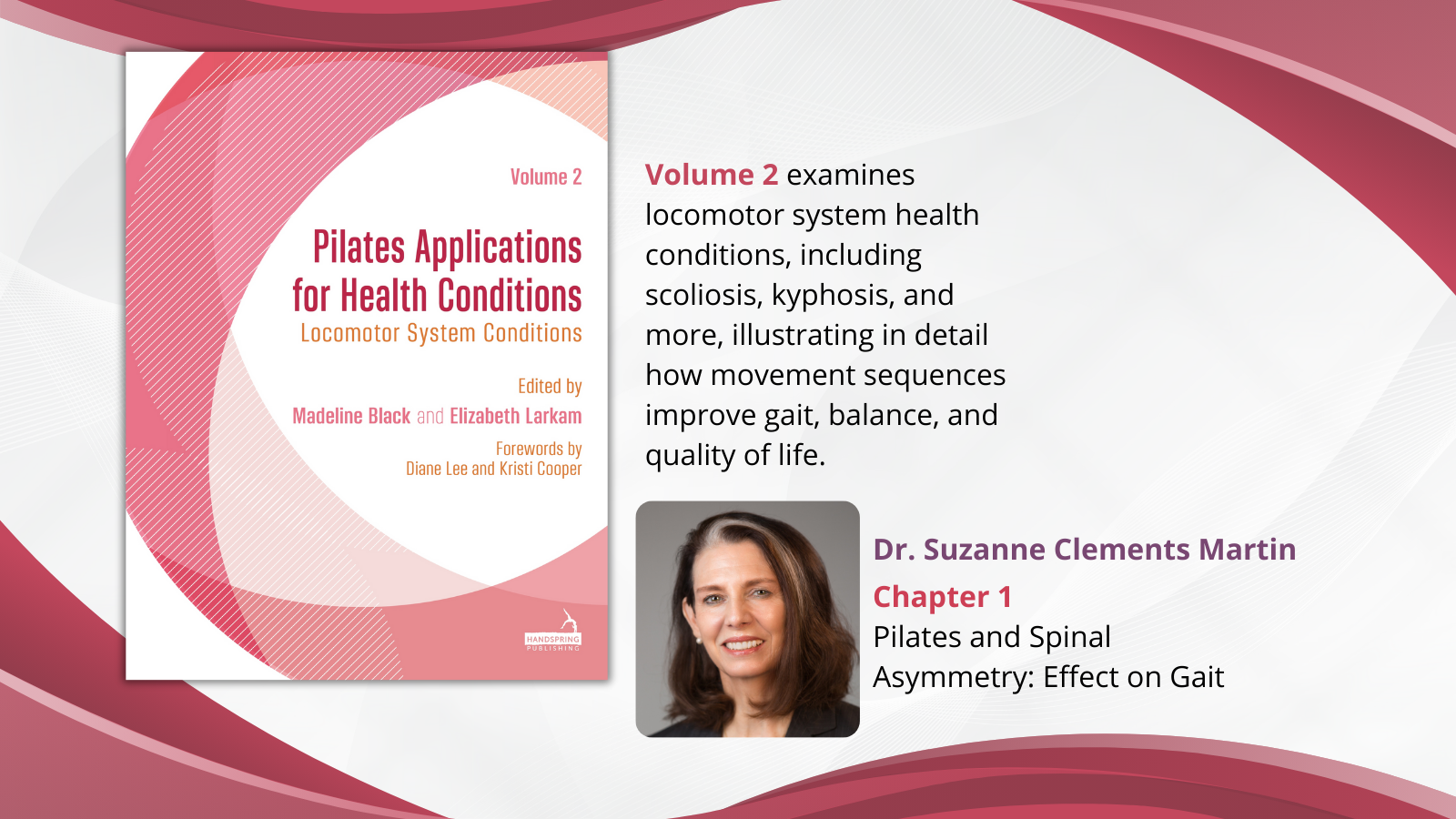
Image with text on the left side: "Volume 2 examines locomotor system health conditions, including scoliosis, kyphosis, and more, illustrating in detail how movement sequences improve gait, balance, and quality of life."
The text on the right side: "Dr. Suzanne Clements Martin | Chapter 1 
Pilates and Spinal Asymmetry: Effect on Gait"

This blog post was written by Dr. Suzanne Clements Martin, contributor to “Chapter 1: Pilates and Spinal Asymmetry: Effect on Gait” in Pilates Applications for Health Conditions Volume 2. This blog post originally appeared in Pilates Intel.

Imprinting is a beloved term used in Pilates

Attributed to our Elder Eve Gentry, imprinting is a subtle action involved with detailed movements of the vertebra in a supine position, where the imprinted motion seeks to “release” the individual vertebrae. In physical therapy terms, it would be called an anterior-posterior Grade 1 or 4 self-mobilization. Contemporary-minded Pilates allows liberty for interpretation. While mobilizing vertebral bones is one way of using the term imprinting, may I suggest others?

Fascia’s Importance

It is no secret that the fascia world concepts have inundated the field of Pilates, yoga, and exercise in general. How fortunate this age is to have new and exciting ways to look at not just fascial anatomy, but actual fascial movement, its connecting impact and coordination with the sensory and psychological self. Already being an advanced mover starting the journey over 25 years ago in cadaver studies, the glaring observation was how abundant the fascia was/is throughout a body, not just humans. Curiosity of fascia’s importance through observation of the outrageous amount of back-up tissue for infrastructure was immensely reassuring for my world, the mover population.

Thanks to interested surgeons, researchers, along with popular anatomists, a clearer, working knowledge of the structure, form, and function continues to emerge.

Continue reading