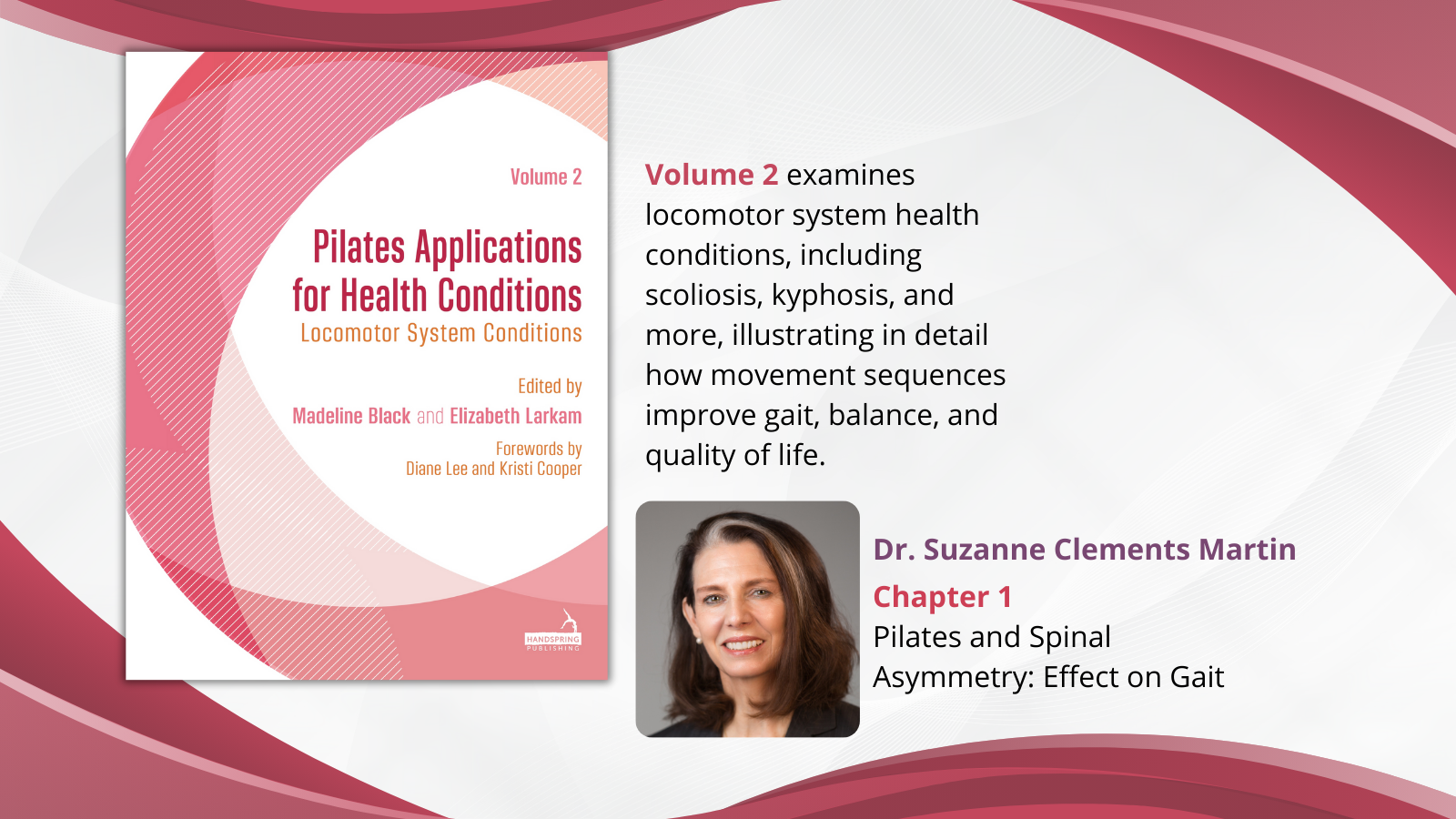
This blog post was written by Dr. Suzanne Clements Martin, contributor to “Chapter 1: Pilates and Spinal Asymmetry: Effect on Gait” in Pilates Applications for Health Conditions Volume 2. This blog post originally appeared in Pilates Intel.
Imprinting is a beloved term used in Pilates
Attributed to our Elder Eve Gentry, imprinting is a subtle action involved with detailed movements of the vertebra in a supine position, where the imprinted motion seeks to “release” the individual vertebrae. In physical therapy terms, it would be called an anterior-posterior Grade 1 or 4 self-mobilization. Contemporary-minded Pilates allows liberty for interpretation. While mobilizing vertebral bones is one way of using the term imprinting, may I suggest others?
Fascia’s Importance
It is no secret that the fascia world concepts have inundated the field of Pilates, yoga, and exercise in general. How fortunate this age is to have new and exciting ways to look at not just fascial anatomy, but actual fascial movement, its connecting impact and coordination with the sensory and psychological self. Already being an advanced mover starting the journey over 25 years ago in cadaver studies, the glaring observation was how abundant the fascia was/is throughout a body, not just humans. Curiosity of fascia’s importance through observation of the outrageous amount of back-up tissue for infrastructure was immensely reassuring for my world, the mover population.
Thanks to interested surgeons, researchers, along with popular anatomists, a clearer, working knowledge of the structure, form, and function continues to emerge.
Continue reading
 Dry Needling for Manual Therapists